

HDB Resale Levy 2026: Who Pays, How Much and How to Calculate It
16 Oct 2026 · 10 min read

CEA Salesperson Registration: R061623D · Huttons Asia Pte. Ltd (Estate Agent Licence L3008899K) · Updated 16 October 2026
“Data-driven property advice. Straight talk, no hype.”
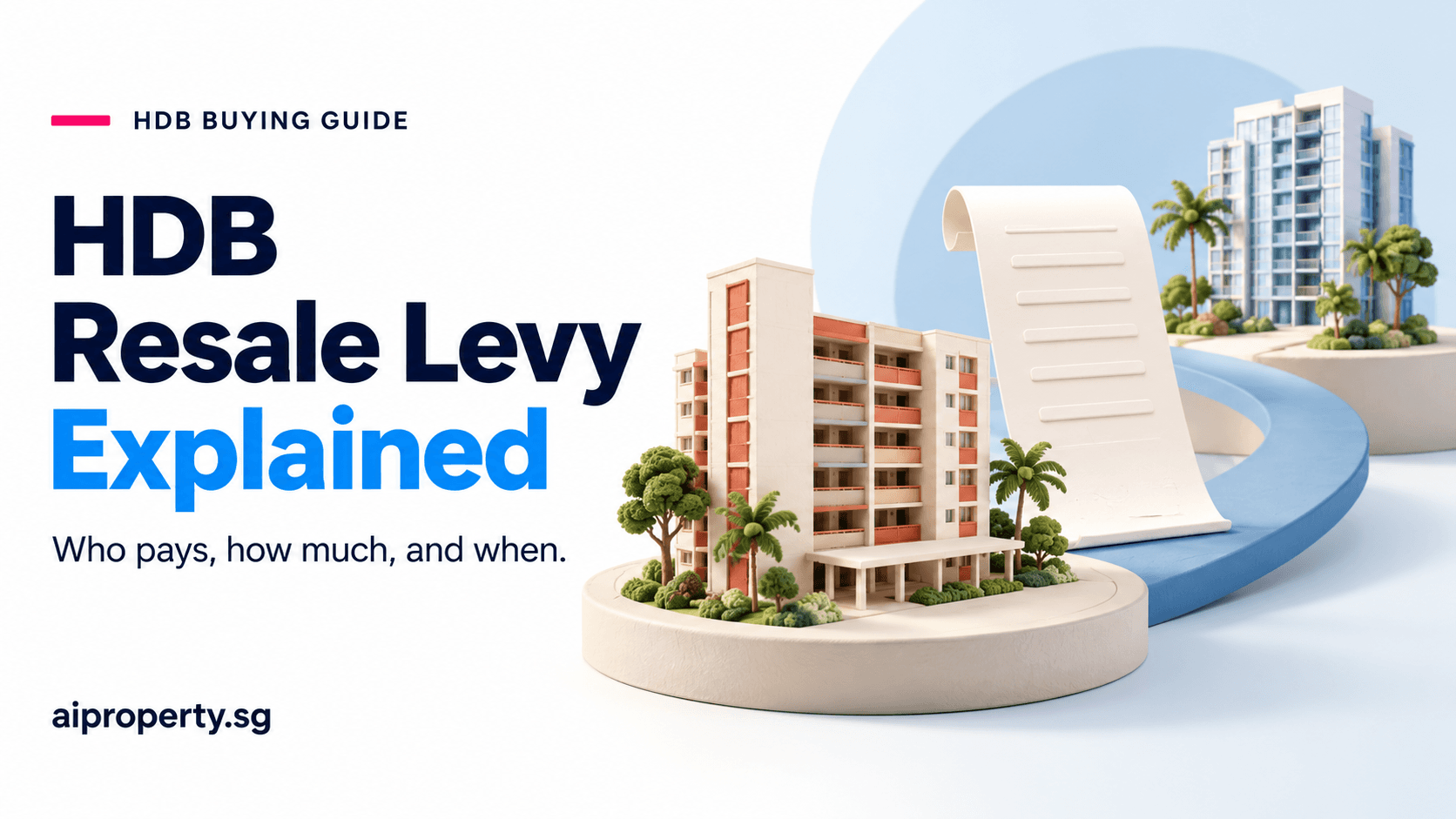
Quick answer: The HDB resale levy is a fixed amount that second-timers pay when they buy another subsidised home after already using a housing subsidy. For a family household it runs from $15,000 to $55,000, set by the type of first home you sold, and Singles Grant recipients pay half. It applies when your next home is a new HDB flat or a new Executive Condominium (EC) from a developer. It does not apply when you buy a resale flat on the open market or private property. It is paid from your sale proceeds or in cash, not from CPF savings or a home loan.
The mistake I see buyers make: treating the levy as a cost of selling. It is not. What triggers it is what you buy next. Sell a subsidised flat and move to a resale flat on the open market, and it never applies. Book a new BTO flat or a new EC, and a fixed bill of $15,000 to $55,000 arrives with it.
I am Winnie Lim, a licensed CEA agent, and this is the first thing I ask upgraders: what are you buying next? That one answer decides whether the levy exists for you. Below is who pays, how much, how to work it out, and how to plan the cash. There is a calculator in the middle of the page.
What the HDB resale levy is, and why it exists
The resale levy is a charge from the Housing & Development Board (HDB) on households who have already enjoyed one housing subsidy and are taking another. Its purpose is fairness. HDB uses it to balance subsidies between first-timers and second-timers, so repeat buyers receive a smaller subsidy on the second home.
For first subsidised flats sold on or after 3 March 2006, the levy is a fixed amount set by flat type, which lets you plan your finances. Before that date it was a percentage of the sale price or valuation. It is separate from stamp duties, which go to IRAS rather than HDB.
Who pays the resale levy
You pay it if you are a second-timer: someone who previously bought a subsidised home and is now buying another one. The trigger is the next purchase.
Your next purchase | Resale levy? |
|---|---|
New BTO or Sale of Balance flat from HDB | Yes |
New Executive Condominium bought from a developer | Yes |
Resale flat bought on the open market | No |
Private property (condo, landed) | No |
A "subsidised home" in this context includes:
- A new flat bought from HDB (BTO or Sale of Balance Flats)
- A DBSS flat
- An Executive Condominium bought from a developer
- A resale flat bought with a CPF Housing Grant
A resale flat bought without any grant generally does not count, so selling one does not create a levy later.
One caution: special household arrangements, such as a couple where one partner is a first-timer and the other a second-timer, can change which grants and levy rules apply. Confirm those cases with HDB before you book.
How much is the resale levy in 2026
These amounts apply when your first subsidised flat was sold on or after 3 March 2006. They are fixed amounts, not a percentage of your sale price.
First subsidised home | Family household | Singles Grant recipient |
|---|---|---|
2-room flat | $15,000 | $7,500 |
3-room flat | $30,000 | $15,000 |
4-room flat | $40,000 | $20,000 |
5-room flat | $45,000 | $22,500 |
Executive flat | $50,000 | $25,000 |
Executive Condominium | $55,000 | HDB lists no amount |
Source: HDB resale levy schedule.
Three things to know about the table:
- Singles Grant recipients pay half. If you used the Singles Grant for your first flat, you pay half the amount when you later form a family and buy a second subsidised flat.
- Sales before 3 March 2006 use a percentage formula. HDB applies 10% to 25% of the higher of the resale price or 90% of market valuation, depending on flat type, and charges interest at 5% per annum if the levy was deferred. Check HDB for your exact case.
- A senior interest waiver exists. If you and your spouse are both 55 or above when you apply for a new 2-room or 3-room flat, you pay only the percentage levy and the interest is waived.
How to calculate your resale levy
Because the levy is a fixed amount, calculating it is a lookup, not a formula.
- Identify your first subsidised home type. Use the flat you sold, or are selling: 2-room, 3-room, 4-room, 5-room, Executive flat or Executive Condominium.
- Check your profile. Are you a family household, or a Singles Grant recipient who has since formed a family?
- Check what you are buying next. The levy applies only if it is a new HDB flat or a new EC from a developer.
Or use the calculator:
HDB confirms the exact figure when you book your second flat, so treat the calculator as a planning estimate.
Worked examples
These are hypothetical scenarios using the levy table above. They are not client cases.
Scenario | First home | Next purchase | Levy |
|---|---|---|---|
Family upgrading from a 4-room flat to a new EC | 4-room | New EC | $40,000 |
Retired couple right-sizing from a 5-room to a new 3-room BTO | 5-room | New BTO | $45,000 |
Owner who bought an EC from a developer, now buying a BTO | EC | New BTO | $55,000 |
Single buyer who used the Singles Grant for a 3-room, now married and buying a BTO | 3-room | New BTO | $15,000 |
Family selling a 4-room and buying a resale flat on the open market | 4-room | Resale flat | $0 |
Take the first row. The family owes $40,000 for moving into a new EC. If they sell their 4-room flat before collecting the EC keys, they pay it in cash when they collect. If they sell after collecting the keys, HDB deducts it from the sale proceeds. Either way, it is a real cash item to budget alongside the downpayment.
For the right-sizing couple, the levy is the cost that hurts most when downsizing, because they are moving to a smaller flat and still paying a levy sized to the larger one they sold. Plan for that before assuming the sale leaves a large cash surplus.
When and how the resale levy is paid
- The amount is fixed at booking. HDB tells you the levy when you book your second flat, and you acknowledge an undertaking to pay it before proceeding.
- Sell first, buy second. You pay the levy in cash when you collect the keys to your second flat.
- Buy first, sell second. HDB deducts the levy from the sale proceeds of your first flat. If the proceeds fall short, you cover the difference in cash.
- It cannot be paid with CPF savings or added to your HDB or bank loan.
The practical point is cash flow. At the moment you are funding a downpayment on the new home, a levy of $30,000 to $55,000 can land on top. See how much cash you need to buy a condo and compare financing in HDB loan vs bank loan. If you are selling first, how to sell your HDB flat covers the timeline.
Can you avoid or reduce the resale levy
You can avoid it by not taking a second subsidy. Buying a resale flat on the open market, or private property, does not trigger the levy.
But do not compare the levy against zero. A resale flat usually costs more per unit than a new BTO, and you may pay Cash Over Valuation on top. Read what COV is and how it works before assuming the resale route is cheaper. The right comparison is the levy plus the new-flat price against the resale price plus COV.
As for waivers, HDB's published relief is limited to the senior interest waiver above. If you believe your circumstances are exceptional, contact HDB directly, as it decides appeals.
Resale levy vs other upgrading costs
Upgraders often mix these up. They are charged by different bodies for different reasons.
Cost | Charged by | When it applies |
|---|---|---|
Resale levy | HDB | Buying a second subsidised home (new HDB flat or new EC) |
ABSD | IRAS | Buying an additional residential property |
Buyer's Stamp Duty | IRAS | Every property purchase |
CPF refund | Your CPF account | When you sell, the CPF you used goes back with accrued interest |
For stamp duty sequencing, see how HDB upgraders avoid ABSD and the ABSD 2026 guide.
The resale levy and Executive Condominiums
ECs are where the levy catches buyers out, because an EC is built by a developer but treated as subsidised housing.
- Buying a new EC as a second-timer triggers the levy. The amount follows your first home type, from $15,000 to $55,000 for a family.
- Owning an EC you bought from a developer counts as a subsidised home. If you later buy a new HDB flat, a family pays $55,000.
- Buying a resale EC on the open market does not trigger the levy. That is one reason resale ECs appeal to upgraders. Read EC MOP rules 2026 for who can buy one.
Eligibility for a new EC also depends on the income ceiling. It depends on the tender date of the site, as explained in the EC income ceiling update. For the full picture of buying a new EC, start with the EC Buyer's Guide.
If you are looking at current EC launches, see Wynwood Grand and Solano Grand. Check the levy into your budget before you pick a unit.
Winnie's take
For second-timers, the levy is not a reason to panic, but it is a reason to plan. Know your number before you book, not after, and treat it as cash, not something your loan will absorb.
If you are choosing between a new flat and a resale flat, do the full comparison: the levy on one side, price and COV on the other. If you are choosing between a new EC and a resale EC, remember that the resale EC skips the levy and comes with no new lock-in, which is worth real money for many upgraders.
The expensive mistake is learning the amount at the booking appointment and discovering your cash plan does not cover it.
By Winnie Lim, licensed CEA agent and founder of AIProperty.sg
Not sure what your resale levy will be?
Send me your first flat type, your profile and the home you want to buy next. I will confirm whether a levy applies, how much, and what it does to your cash plan. Message me on WhatsApp for a resale levy check.
Common questions about the HDB resale levy
Who has to pay the HDB resale levy?
Second-timers pay it: households that previously bought a new HDB flat, a DBSS flat, an Executive Condominium from a developer, or a resale flat with a CPF Housing Grant, and now buy another subsidised home. In practice that means a new flat from HDB or a new EC from a developer. Buying resale on the open market does not trigger it.
How much is the HDB resale levy in 2026?
For a first subsidised home sold on or after 3 March 2006, a family household pays $15,000 (2-room), $30,000 (3-room), $40,000 (4-room), $45,000 (5-room), $50,000 (Executive flat) or $55,000 (Executive Condominium). Singles Grant recipients pay half. Earlier sales use a percentage formula.
Can I pay the resale levy with CPF?
No. The levy cannot be paid with CPF savings or added to your HDB or bank loan. You pay it in cash, or it is deducted from the sale proceeds of your first flat if you sell after collecting the keys to your second. Budget it as a cash cost.
Do I pay the resale levy if I buy a resale flat?
No, not for a resale flat bought on the open market. The levy is charged when you take a new subsidised home, meaning a new HDB flat or a new EC from a developer. Private property carries no levy either. Confirm edge cases, such as mixed first-timer and second-timer couples, with HDB.
Does the resale levy apply to ECs?
Yes, in two ways. A second-timer buying a new EC from a developer pays the levy. And an EC you bought from a developer counts as a subsidised home, so buying a new HDB flat later costs a family $55,000. Buying a resale EC on the open market does not trigger the levy.
Do singles pay a lower resale levy?
Yes, if you received the Singles Grant for your first flat. You pay half the family amount when you later form a family and buy a second subsidised flat, from $7,500 to $25,000 depending on the first flat type. HDB lists no Singles Grant amount for the Executive Condominium row.
Can the resale levy be waived?
HDB's published relief is limited to waiving interest on a deferred pre-2006 percentage levy for couples who are both 55 or above and buying a new 2-room or 3-room flat. If you believe your circumstances are exceptional, contact HDB directly, because it decides any appeal.
How is the resale levy calculated?
It is a fixed amount set by the type of first subsidised home you sold and whether you are a family household or a Singles Grant recipient, not a percentage of your sale price. Match your first home type to the table, then confirm HDB's figure at flat booking. Sales before 3 March 2006 use a percentage formula.
Planning your next move?
Start with the EC Buyer's Guide if an EC is on your list, then check your borrowing in the affordability calculator and mortgage calculator. If your income is near the cap, read how the HDB income ceiling change affects you. When you have a shortlist, message me on WhatsApp and I will build the numbers with you.
This article is for general information only and should not be considered financial, legal, tax, or investment advice. Property decisions should be based on individual circumstances and independent professional advice.
About the Author
Winnie Lim is a licensed CEA real estate agent and the founder of AIProperty.sg. With a background in supply chain analytics, she brings a data-driven approach to Singapore property, and won the 2024 Million Dollar Award for consistent, client-first results.
CEA Salesperson Registration: R061623D · Huttons Asia Pte. Ltd (Licence L3008899K)
Read full bio →Continue Reading
More from Buying Guide
HDB Valuation Request (Request for Value): A Step-by-Step Guide for Resale Buyers
How to submit an HDB Request for Value: who submits, the $120 fee, the 10-working-day wait, 3-month validity, and what to do if the value is low.
09 Oct 2026
HDB Loan vs Bank Loan: Which Is Cheaper in 2026?
Bank loans for HDB flats start near 1.5% against HDB's 2.6%. Here is the real monthly and 25-year cost, the cash you need, and when HDB still wins.
09 Oct 2026
What Is Cash Over Valuation (COV)? How COV Works for HDB Resale in Singapore (2026)
COV is the cash you pay above an HDB flat's valuation. How it works, how much cash you need, what to do if the valuation comes in low, and 2026 trends.
05 Oct 2026