

EC MOP Rules 2026: 5 vs 10 Years, Who Can Buy a Resale EC, and the Resale Levy
25 Sept 2026 · 9 min read

CEA Salesperson Registration: R061623D · Huttons Asia Pte. Ltd (Estate Agent Licence L3008899K) · Updated 25 September 2026
“Data-driven property advice. Straight talk, no hype.”
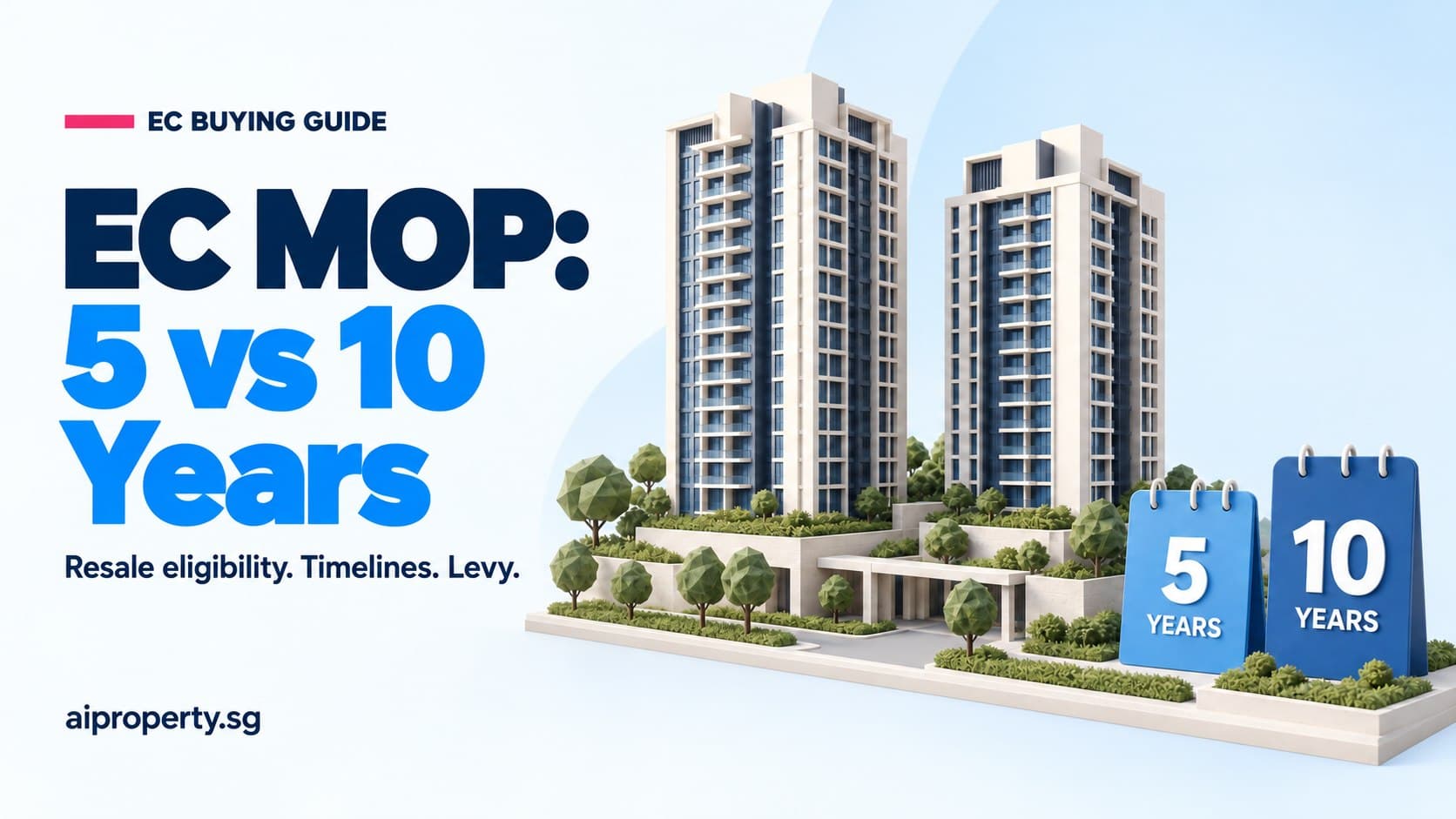
Quick answer: The Executive Condominium (EC) Minimum Occupation Period (MOP) is now either 5 or 10 years, depending on when the land was sold. ECs on Government Land Sales (GLS) sites whose tenders closed before 8 May 2026 keep the 5-year MOP, and can then be sold to Singapore Citizens and Permanent Residents, or to anyone after year 10. Sites with tenders closing on or after 8 May 2026 carry a 10-year MOP and full privatisation after year 15. Buying a resale EC does not trigger the resale levy. A second-timer buying a new EC from a developer does.
The mistake I see buyers make: reading the 8 May 2026 announcement as though it applies to every EC. It does not. There are now two kinds of EC, and the rule attached to yours decides when you can sell, who can buy it from you, and what it may be worth.
I am Winnie Lim, a licensed CEA agent, and this is the question I now get on every EC enquiry. Here is what the Ministry of National Development (MND) confirmed, how to check which rule covers a project, and what the split means for resale prices.
What the EC MOP is, and why there are two versions
An Executive Condominium is a condo built and sold by a private developer with public-housing conditions attached for its first years. MND says developers price ECs around 20% to 30% below comparable private condos because of those conditions.
The MOP is the lock-in. During it you cannot sell the unit, rent out the whole unit, or buy another residential property. HDB computes the MOP from the date of the Temporary Occupation Permit (TOP), not from the date you sign or collect keys.
On 8 May 2026 MND announced three changes for EC sites with tender closing dates on or after that day. The MOP doubled to 10 years, full privatisation moved from year 10 to year 15, and the Deferred Payment Scheme (DPS) was withdrawn. Every EC already built, sold or tendered before that date keeps the old timeline.
The two sets of rules, side by side
Rule | Tender closed before 8 May 2026 | Tender closing on or after 8 May 2026 |
|---|---|---|
MOP | 5 years from TOP | 10 years from TOP |
Who can buy after the MOP | Singapore Citizens and PRs | Singapore Citizens and PRs, years 10 to 15 |
Full privatisation, open to anyone including foreigners and companies | After year 10 | After year 15 |
Deferred Payment Scheme | Allowed | Withdrawn, Normal Payment Scheme only |
First-timer quota | 70% of units | 90% of units |
First-timer priority period | 1 month from launch | 2 years from launch |
Source: MND press release, 8 May 2026, and HDB's conditions for EC owners.
The middle rows are what matter to a buyer. A new-rule EC bought in 2027 and completed around 2030 stays locked until about 2040. A lot changes in a household over ten years: a job move, a second child, parents moving in.
How to check which rule applies to your EC
Most existing owners can stop worrying. If you already own an EC, or bought one before May 2026, you are on the 5-year MOP. For anything newer, check in this order:
- Find the GLS tender closing date for the site. URA publishes it with every land sale result.
- Check whether the project is one of the five sites still under the old rules: Senja Close (CDL, 302 units), Woodlands Drive 17 Plot 1 (CDL), Woodlands Drive 17 Plot 2 (Sim Lian), Sembawang Road (Oriental Pacific) and Miltonia Close (Hoi Hup).
- Confirm the MOP and privatisation terms in the developer's sales documents and on HDB's EC pages before you commit.
Those five sites also sit on the older $16,000 income ceiling, which I covered in the EC income ceiling explainer. HDB's own eligibility page now states it plainly: $18,000 for EC projects with tenders closing on or after 24 August 2026, and $16,000 for sites awarded before that date.
Who can buy a resale EC
A resale EC is one past its MOP but not yet fully privatised. The buyer rules are looser than for a new EC, which is why resale ECs appeal to people shut out of new launches.
- Citizenship. Singapore Citizens and PRs can buy. Foreigners must wait for full privatisation.
- Singles. A single buyer can purchase a resale EC from age 21, with no family nucleus required. For a new EC or a resale HDB flat, singles generally have to be 35.
- Income ceiling. None. The ceiling applies only to new EC purchases from a developer.
- HDB owners. A citizen who has met the HDB MOP can keep the flat, though Additional Buyer's Stamp Duty (ABSD) then applies to the EC as a second property. A PR must dispose of an HDB flat.
- Grants. CPF housing grants do not apply to resale ECs.
That makes a resale EC the most direct route into condo living for a single buyer under 35, or a household earning above the new-EC ceiling. Confirm your own position with HDB or your conveyancing lawyer before you commit, since the resale rules turn on the specific project's MOP and privatisation status. For the new-EC rules, see our EC Buyer's Guide.
The resale levy: when you pay it, and when you do not
The resale levy reduces the subsidy on a second subsidised home. What triggers it is what you buy next, not what you sell.
You pay it if you are a second-timer buying a new EC from a developer or a new flat from HDB. You do not pay it when you buy a resale EC, or a resale flat, or private property on the open market, because none of those carries a fresh subsidy.
First subsidised home sold on or after 3 March 2006 | Resale levy, families | Resale levy, singles grant basis |
|---|---|---|
2-room or 2-room Flexi | $15,000 | $7,500 |
3-room | $30,000 | $15,000 |
4-room | $40,000 | $20,000 |
5-room | $45,000 | $22,500 |
Executive flat | $50,000 | $25,000 |
Executive Condominium | $55,000 | $27,500 |
HDB confirms the EC figures directly: $55,000 for families and $27,500 for singles. Sales before 3 March 2006 use a percentage formula instead.
On a 4-room upgrade that is $40,000 of cash or CPF a resale EC buyer keeps.
Resale EC against new EC: the price gap
Resale ECs near the pipeline sites still price well below new private condos. Averages reported for 2025 put three-bedders at about $1.33 million at Blossom Residences, $1.35 million at Signature at Yishun and $1.39 million at Bellewoods, with four-bedders at Twin Fountains around $1.68 million.
Land cost pushes the other way for new launches. The five old-rule sites sold for $692 to $794 per square foot per plot ratio, with Woodlands Drive 17 Plot 2 setting an EC record at $794. Those land costs set a floor under launch prices before the new rules take any effect.
My read on the two-tier market: once new-rule ECs start launching, the ECs that can be resold after five years become a finite pool, and that scarcity may support their prices. At the same time, analysts expect new-rule launches to price about 5% to 7% below current median launch prices, to compensate buyers for the longer lock-in. Neither effect is guaranteed, and I would not buy on either assumption alone.
The catch buyers often miss
A cheaper new-rule EC is not a win if the 10-year MOP does not fit your life. You cannot sell, rent the whole unit out, or buy another home for a decade. If there is a real chance you need to move inside that window, the discount buys you very little.
The payment side changed too. Under the old rules the DPS let buyers pay 20% upfront and defer the rest until TOP, at a premium of roughly 2% to 3%. New-rule buyers go on the Normal Payment Scheme, so progressive payments and loan interest start during construction. If you still hold an HDB flat during the build, check your cash flow for that overlap.
Worked example: resale EC or pipeline EC?
A hypothetical, not a client case. A second-timer couple upgrading from a 4-room flat they have already sold, comparing a resale EC against a new EC at one of the five pipeline sites, both at $1.4 million for illustration.
Line item | Resale EC | New pipeline EC |
|---|---|---|
Purchase price | $1,400,000 | $1,400,000 |
Buyer's Stamp Duty | $40,600 | $40,600 |
Resale levy | $0 | $40,000 |
CPF housing grant | None | None, as second-timers |
Minimum cash downpayment, 5% | $70,000 | $70,000 |
Cash or CPF downpayment, 20% | $280,000 | $280,000 |
Bank loan at 75% | $1,050,000 | $1,050,000 |
Loan limit test | Total Debt Servicing Ratio (TDSR) | TDSR and Mortgage Servicing Ratio (MSR) |
MOP | Already served | 5 years from TOP |
On these assumptions the resale EC saves $40,000 upfront and comes with no lock-in. The new EC gives you a brand-new unit, the pipeline sites may still offer DPS, and your MOP clock only starts at TOP. The right answer depends on the loan you qualify for, so run your own numbers in the mortgage calculator first. If you plan to keep your flat, how HDB upgraders avoid ABSD covers the stamp duty side.
Who should buy what
Buyer | My read |
|---|---|
Single under 35, or a household above the new-EC income ceiling | Resale EC. Often the only EC route open to you |
Second-timer HDB upgrader | Compare resale ECs first. The $30,000 to $55,000 levy saving is real money |
First-timer family that may move within 10 years | A pipeline site or a resale EC, to keep a 5-year exit |
First-timer family staying 10 years or more | New-rule launches are worth waiting for, given the 90% quota and possible lower pricing |
Owner of a pre-2026 EC | No need to rush a sale because of the rule change |
If you are weighing drop-out units from recent launches as a middle path, read whether drop-out EC units are worth waiting for.
Not sure which EC rule applies to you?
I can check a specific project's MOP and privatisation timeline, and model a resale EC against a new launch with cash, CPF and loan set out line by line. Message me on WhatsApp for an EC eligibility and affordability check.
Winnie's take
For most second-timer upgraders I would look at resale ECs before new launches. You skip the $30,000 to $55,000 levy, there is no lock-in, and you can see the actual unit. The trade-off is an older building and no grants.
For first-timer families planning to stay a decade, the new rules work in your favour. The 90% quota, the two-year priority window and a possible 5% to 7% price cushion are worth waiting for.
The risk sits with buyers who take a 10-year MOP without a ten-year plan. Before you book a new-rule unit, write down where your household will be in 2036, and check you would still be content living there.
By Winnie Lim, licensed CEA agent and founder of AIProperty.sg
Common questions about EC MOP and resale ECs
Is the EC MOP 5 or 10 years?
It depends on the land sale date. ECs on GLS sites whose tenders closed before 8 May 2026, which covers every existing EC and five pipeline sites, have a 5-year MOP. Sites with tenders closing on or after 8 May 2026 carry a 10-year MOP. HDB computes both from the date of the Temporary Occupation Permit.
Can I sell my EC to a foreigner?
Yes, once it is fully privatised. For old-rule ECs that is after year 10, and for new-rule ECs after year 15. Between the MOP and privatisation you can sell only to Singapore Citizens and Permanent Residents.
Can singles buy a resale EC?
Yes. A single Singapore Citizen or PR aged 21 and above can generally buy a resale EC that has passed its MOP, with no income ceiling and no family nucleus required. Confirm the conditions for the specific project with HDB before you commit.
Do I pay the resale levy on a resale EC?
No. The levy applies when a second-timer takes another housing subsidy, such as a new EC from a developer or a new flat from HDB. A resale EC bought on the open market carries no subsidy, so no levy applies.
Can I buy private property during the EC MOP?
No. EC owners cannot buy another residential property during the MOP, which is 5 years for old-rule ECs and 10 years for new-rule ECs. The restriction lifts when the MOP ends.
Planning your EC move?
Start with the EC Buyer's Guide for new-EC eligibility, then the Woodlands EC comparison if you are looking north. When you have a shortlist, message me on WhatsApp and I will match resale ECs and pipeline launches to your budget and your exit timeline.
This article is for general information only and should not be considered financial, legal, tax, or investment advice. Property decisions should be based on individual circumstances and independent professional advice.
About the Author
Winnie Lim is a licensed CEA real estate agent and the founder of AIProperty.sg. With a background in supply chain analytics, she brings a data-driven approach to Singapore property, and won the 2024 Million Dollar Award for consistent, client-first results.
CEA Salesperson Registration: R061623D · Huttons Asia Pte. Ltd (Licence L3008899K)
Read full bio →Continue Reading
More from Buying Guide

EC Income Ceiling Raised to $18,000: Why the Next 5 Executive Condos Still Play by the Old Rules
The EC income ceiling rose to $18,000 on 24 August 2026, but Senja Close, Sembawang Road, Miltonia Close and both Woodlands Drive 17 plots still run on $16,000. Here is which rules apply to which project.
18 Sept 2026
HDB Income Ceiling Raised to $16,000: What It Means for BTO and Resale Buyers
The HDB income ceiling rose to $16,000 for families and $8,000 for singles on 24 August 2026, the first change since 2019. What it means for your BTO odds, resale prices and the million-dollar flat trend.
18 Sept 2026
Is En Bloc Only for Freehold Condos? Freehold vs Leasehold in Singapore
Buying an HDB hoping for 'en bloc potential'? Here's what SERS and VERS odds really look like, and what actually holds resale value while you wait. Is en bloc only for freehold condos?
11 Sept 2026