

Is En Bloc Only for Freehold Condos? Freehold vs Leasehold in Singapore
11 Sept 2026 · 8 min read

CEA Salesperson Registration: R061623D · Huttons Asia Pte. Ltd (Estate Agent Licence L3008899K) · Updated 15 September 2026
“Data-driven property advice. Straight talk, no hype.”

Quick answer: No—en bloc potential is not exclusive to freehold properties. An older freehold condo may appeal to long-term owners because of its perpetual tenure and scarcity, but tenure alone does not make an en bloc sale likely or guarantee stronger returns.
For buyers holding a property for only four to five years, a well-located 99-year leasehold condo with strong resale demand can be a better choice than an older freehold project. What matters most is the specific development: its location, land value, redevelopment upside, owner profile, maintenance condition, entry price and eventual buyer demand.
Why buyers link freehold properties to en bloc
Freehold property has a powerful appeal in Singapore. Land is scarce, the tenure does not run down, and many buyers see freehold homes as assets that can be held for decades or passed to children.
That makes older freehold condos natural candidates for an en bloc narrative. When buyers see a 40-, 50- or 60-year-old freehold project on a sizeable plot near an MRT station or established amenities, they often imagine a developer buying the site, rebuilding it and delivering a windfall to owners.
There is logic behind that thinking. But it is incomplete.
An en bloc sale happens only when the development makes commercial sense for a developer and when owners can agree on a sale. Freehold status may improve the story, but it does not replace the other fundamentals.
The proposed changes to Singapore’s collective-sale rules would lower consent thresholds for older private developments: 70% for projects aged 40 to 59 years, and 65% for projects aged 60 years and above. Developments below 40 years old would continue to require 80% consent, while those below 10 years old require 90%.
That may make it easier for some ageing estates to begin a collective-sale process. It does not mean every older development will go en bloc.
What actually makes a property attractive for en bloc?
A credible en bloc candidate usually has several conditions working together.
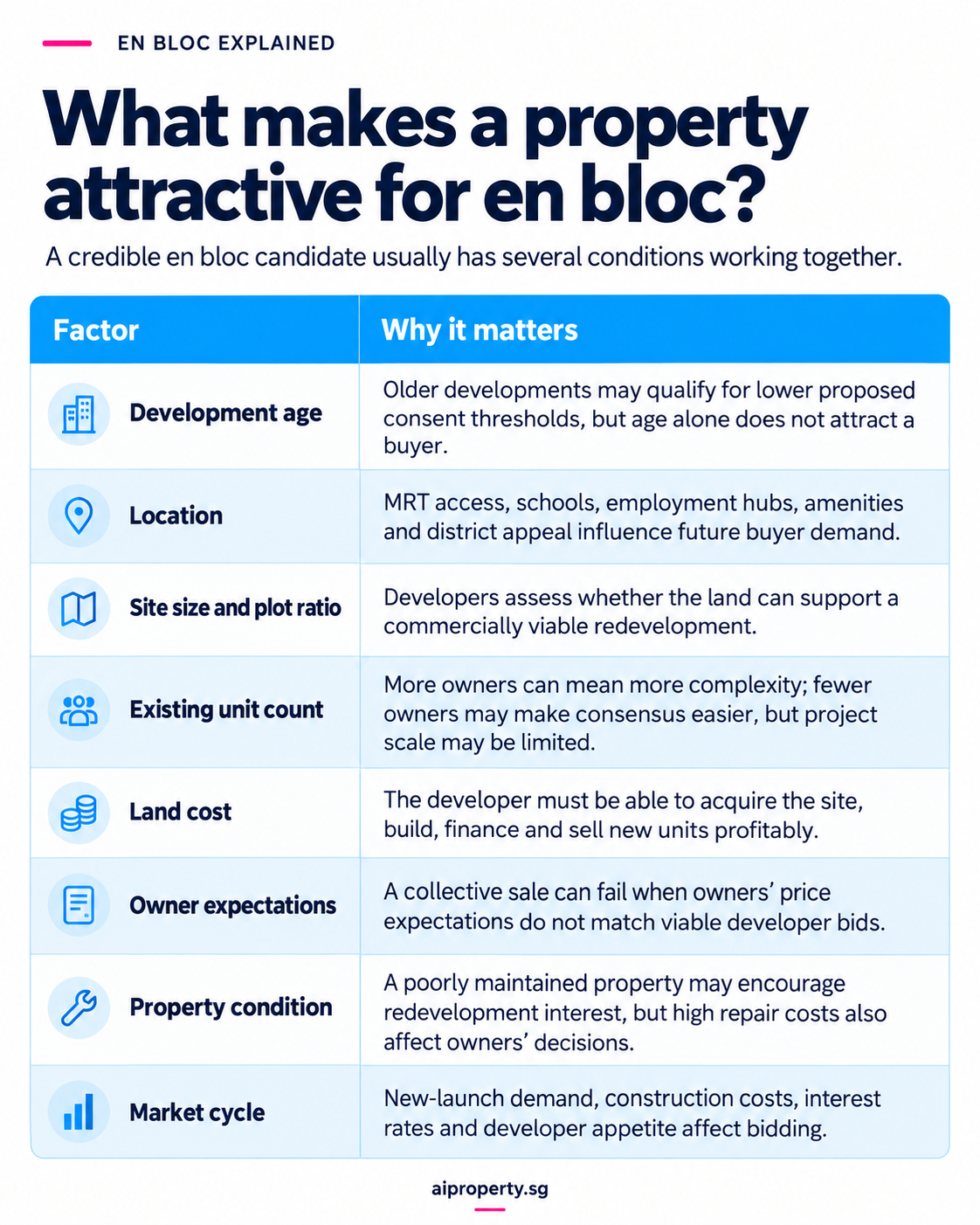
The key distinction is this: en bloc potential is a site-and-market question, not simply a tenure question.
A 99-year leasehold development in a prime, transport-connected location with redevelopment potential may draw developer interest. Conversely, an older freehold property can struggle to secure a buyer if the land price is too high, the site has limited redevelopment upside or owners insist on an unrealistic reserve price.
The new thresholds: helpful, but not a guarantee
The proposed changes aim to address the reality that Singapore’s private housing stock is ageing. Many developments built decades ago now face higher maintenance needs, changing owner demographics and questions about whether refurbishment or redevelopment makes better sense.
For developments aged 40 to 59 years, the proposed threshold would fall from 80% to 70%. For those aged 60 years or more, it would fall from 80% to 65%.
That could help some developments where a majority of owners support redevelopment but achieving 80% consent has been difficult.
However, the threshold is only one stage of the process. Owners must still form a collective sale committee, appoint professional advisers, conduct a proper marketing process, receive credible offers and navigate the legal safeguards that protect objecting owners.
The proposal also includes stronger process controls. For example, a higher proportion of owners would be needed to call a meeting to form a collective sale committee, while the period for collecting signatures would be shortened and the waiting period after a failed attempt extended.
In other words, the policy is designed to make viable redevelopment easier—not to make en bloc sales automatic.
Should short-term buyers choose leasehold instead?
A buyer who plans to hold a property for only four to five years has a different objective from a family buying a legacy home or a retiree planning for the next 20 years.
For a shorter holding period, the investment case should focus less on perpetual tenure and more on the property’s likely resale market at the point of exit.
Ask these questions:
- Is the project near an MRT station, schools, employment hubs or established amenities?
- Does the unit have a practical size, layout, facing and floor level?
- Is the purchase price comparable with nearby alternatives?
- Are there upcoming launches that may compete for the same pool of buyers?
- Is there a sufficiently broad resale and rental market?
- How much renovation, repair or maintenance expenditure will the property require?
- Will the next buyer see value at your intended resale price?
A newer leasehold condo may sometimes offer a stronger short-term proposition because it has a more modern layout, lower near-term maintenance risk, broader demand and more predictable competition within its location.
That does not make leasehold inherently superior. It means the buyer’s time horizon should determine the criteria.
A practical example
Imagine two homes in broadly similar city-fringe locations:
Option | Older freehold condo | Newer 99-year leasehold condo |
|---|---|---|
Age | 35 to 45 years | 5 to 10 years |
Buyer appeal | Freehold scarcity and possible redevelopment narrative | Modern facilities, newer condition and easier owner occupation |
Renovation | May require substantial upgrading | Usually more manageable |
En bloc potential | Possible, but uncertain | Lower in the near term due to project age |
Short-term resale | Depends heavily on price and buyer confidence | May have broader appeal if well-located and competitively priced |
Main risk | Paying today for an en bloc outcome that never materialises | Lease decay matters more over a much longer horizon |
If the buyer expects to sell in four years, the newer leasehold unit can be the more rational choice if it is easier to live in, easier to rent and easier to resell.
If the buyer expects to retain the property for decades, freehold scarcity may deserve more weight; provided the price, condition and location remain sensible.
What about buyers purchasing HDB flats for future potential?
The same thinking applies to HDB resale buyers who are looking beyond immediate owner occupation.
Some private-property owners sell a one- or two-bedroom condo and move into a larger four-room HDB resale flat for more liveable space. They may look for a corner unit, higher floor, squarish layout, MRT proximity and a mature or well-connected location.
These features can make an HDB unit more appealing to future buyers. But they should not become an excuse to overpay.
A seller may believe a rare layout deserves a premium. The market will decide whether that premium is justified. Buyers should compare recent transactions, remaining lease, ethnic quota availability, floor level, condition and competing listings before committing.
The same rule applies across every segment of the market: a property is worth what a qualified buyer is prepared and able to pay; not what the owner hopes its future potential might be.
What foreign buyers should consider
Foreign buyers can purchase private condominium units in Singapore, subject to applicable rules and taxes. For most foreigners purchasing residential property, Additional Buyer’s Stamp Duty is currently 60%, on top of Buyer’s Stamp Duty. The duty is generally calculated on the higher of the purchase price or market value.
That high upfront tax cost can make long-term holding more important for foreign investors. It may also explain why some foreign buyers place greater emphasis on freehold tenure.
But freehold is still not a shortcut to investment success. A foreign buyer should assess:
- The all-in acquisition cost after ABSD and Buyer’s Stamp Duty.
- The likely holding period.
- Rental demand and net yield after costs.
- Exit liquidity.
- Currency exposure where relevant.
- The property’s resale market among local and international buyers.
- Whether the price already includes a substantial freehold or en bloc premium.
Freehold vs leasehold: the better question
Instead of asking, “Is freehold better than leasehold?”, ask:
“Which property best matches my ownership period, budget, lifestyle needs and exit plan?”
A freehold property may suit you if you are buying for long-term family ownership, building a legacy asset for future generations, comfortable holding through multiple market cycles, prepared to maintain an older property where necessary, and buying at a price that remains sensible even without an en bloc sale.
A leasehold property may suit you if you are focused on a four- to 10-year holding period, prioritising location, convenience and resale demand, seeking a newer development with lower renovation needs, buying primarily for own stay and practical liveability, or looking for a more affordable entry point in a preferred district.
Before you buy for en bloc potential
Treat an en bloc possibility as a bonus, not a promise. Before paying a premium for an older development, work through these eight questions:
- Would I still buy this property if it never goes en bloc?
- Is the current asking price supported by recent comparable sales?
- Is the location likely to remain attractive to owner-occupiers and tenants?
- What is the condition of the estate, and are major repairs likely?
- Does the site have meaningful redevelopment potential?
- Is there evidence that owners are aligned on price and timing?
- Could a developer realistically make a profitable offer at the price owners expect?
- Who is likely to buy this property from me when I want to sell?
The bottom line
Freehold properties can be excellent long-term holdings, and some older freehold developments may benefit from the proposed lower en bloc consent thresholds. But freehold ownership does not guarantee an en bloc sale, capital appreciation or a better four-year investment outcome.
For short-term buyers, location, unit quality, affordability and resale liquidity often matter more than tenure. For long-term buyers, freehold may be worth considering but only when the property itself makes sense at today’s price.
The best purchase is not the property with the most exciting en bloc story. It is the one that still works for you if that story never happens.
Winnie's take
This is where many buyers get the story wrong: they buy a freehold property because it might go en bloc, rather than buying a home they would still be happy to own if it never does.
I like older freehold condos when the fundamentals stand on their own; good location, sensible entry price, usable layout, manageable upkeep and a buyer pool that will still be there years from now. The possibility of an en bloc sale is upside. It should not be the reason you stretch your budget
For a buyer with a four- or five-year holding plan, I would usually put liquidity ahead of tenure. A well-priced 99-year leasehold condo close to an MRT station, with the right unit size and genuine resale demand, can be much easier to exit than an ageing freehold project carrying a large “en bloc premium”.
Do not buy the word freehold. Buy the specific unit, the entry price, the location and the future buyer. If you are not sure, message me on WhatsApp for a free check.
This article is for general information only and should not be considered financial, legal, tax, or investment advice. Property decisions should be based on individual circumstances and independent professional advice.
About the Author
Winnie Lim is a licensed CEA real estate agent and the founder of AIProperty.sg. With a background in supply chain analytics, she brings a data-driven approach to Singapore property, and won the 2024 Million Dollar Award for consistent, client-first results.
CEA Salesperson Registration: R061623D · Huttons Asia Pte. Ltd (Licence L3008899K)
Read full bio →Continue Reading
More from Buying Guide

You Got 90% Consent for En Bloc. Here's Why the Deal Still Isn't Done
Consent is step four of seven. Here's what the valuer, the law and the Strata Titles Board still decide after your committee clears 90%, and why a below-market offer can't legally go through.
11 Sept 2026
Singapore’s Postal Code and District Directory 2026
Find any Singapore property district using the first two digits of its postal code. See all D1-D28 postal sectors, neighbourhoods and new-launch links.
24 Aug 2026
The 15-Month Wait-Out Period Is Gone: What Private Downgraders Must Know Before Buying an HDB
On 28 July 2026 the 15-month wait-out for private owners buying an HDB resale flat was removed with immediate effect. Two real client stories show the catches that remain: the 30-month HDB loan rule and the ethnic quota.
03 Aug 2026