

How Much Home Loan Can I Get in Singapore? TDSR, MSR and LTV by Income (2026)
05 Oct 2026 · 10 min read

CEA Salesperson Registration: R061623D · Huttons Asia Pte. Ltd (Estate Agent Licence L3008899K) · Updated 2 October 2026
“Data-driven property advice. Straight talk, no hype.”
Quick answer: A Singapore bank lends you the smallest of three limits. All your monthly debt repayments together can take up to 55% of your gross income (the Total Debt Servicing Ratio, or TDSR). If you are buying an HDB flat or a new executive condo, the mortgage alone is capped at 30% (the Mortgage Servicing Ratio, or MSR). And the loan cannot exceed 75% of the price (the Loan-to-Value limit, or LTV). Banks test your repayments at a 4% interest rate, whatever your package charges. On a $10,000 household income with no other loans, that gives a maximum home loan of about $1.15 million for a private condo and about $628,000 for a new EC.
Most buyers learn their real borrowing limit from an In-Principle Approval letter. The figure on it is usually lower than the one they worked out on their phone the week before, sometimes by a quarter of a million dollars. That gap has a cause, and you can calculate it yourself before you see a single showflat.
This guide works the way your bank does. It starts with your income, turns it into the largest monthly instalment the rules allow, converts that into a loan, and only then asks what price the loan can carry.
How do banks work out your maximum home loan?
Your maximum home loan is the lowest of three numbers, and the one that bites depends on what you are buying.
- TDSR: 55% of your gross monthly income, minus every other monthly debt you carry, converted into a loan amount.
- MSR (HDB flats and new ECs only): 30% of your gross monthly income, converted the same way.
- LTV: 75% of the purchase price or the bank's valuation, whichever is lower, on your first housing loan.
The conversion step is where most people's arithmetic goes wrong. Banks do not plug in the rate you will pay. Under MAS rules they assume a medium-term rate of at least 4% a year for a residential loan, and they spread it over your loan tenure, which for a private property means up to 30 years if you want the full 75% LTV.
At 4% over 30 years, every $1,000 of monthly repayment supports roughly $209,000 of loan. Keep that ratio in your head. It explains almost every number in this article.
If you already have a price in mind and want to see the monthly cost, our mortgage calculator Singapore runs it the other way round.
Maximum home loan by income in 2026
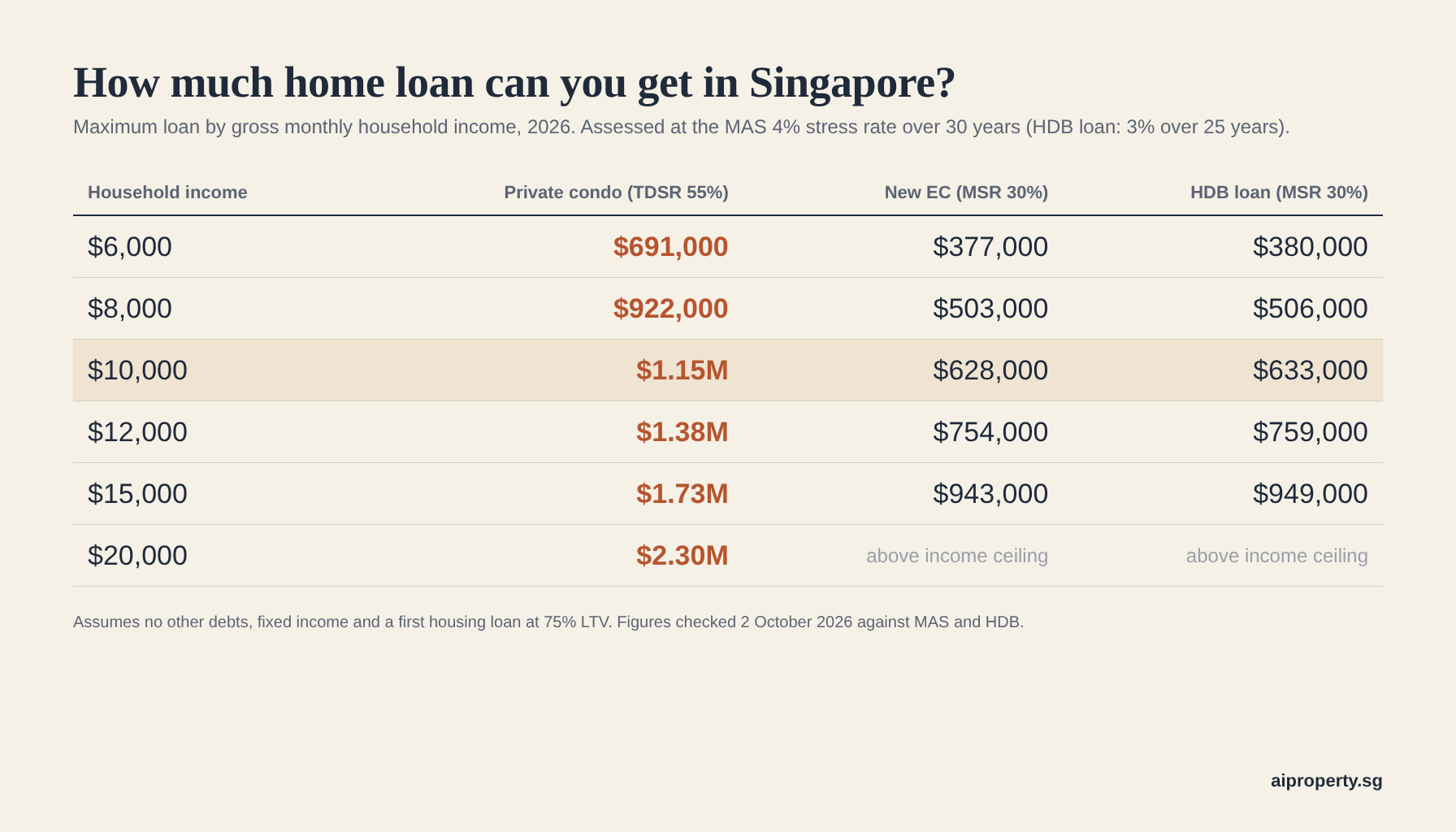
Here is the table most buyers are looking for. It assumes no other debts, fixed salary income, a first housing loan, a 30-year tenure at the 4% assessment rate for bank loans, and HDB's own rules for HDB loans (3% over 25 years).
Gross monthly household income | Private condo: max loan (TDSR) | Price reachable* | New EC: max loan (MSR) | Price reachable* | HDB loan: max loan | Price reachable* |
|---|---|---|---|---|---|---|
$6,000 | $691,000 | $922,000 | $377,000 | $503,000 | $380,000 | $506,000 |
$8,000 | $922,000 | $1.23 million | $503,000 | $670,000 | $506,000 | $675,000 |
$10,000 | $1.15 million | $1.54 million | $628,000 | $838,000 | $633,000 | $844,000 |
$12,000 | $1.38 million | $1.84 million | $754,000 | $1.01 million | $759,000 | $1.01 million |
$15,000 | $1.73 million | $2.30 million | $943,000 | $1.26 million | $949,000 | $1.27 million |
$20,000 | $2.30 million | $3.07 million | Above EC income ceiling | n/a | Above HDB income ceiling | n/a |

*Price reachable assumes you can fund the minimum 25% downpayment plus stamp duty. A bigger downpayment lets you buy above this price with the same loan.
The EC column is about 45% smaller than the private column at every income, and the reason is simple: 30% of your pay runs out long before 55% does. At $16,000, which is the EC income ceiling for the launches now in the pipeline, the MSR stops the loan at about $1.005 million. With a 25% downpayment, that reaches a price of about $1.34 million and no further.
Total Debt Servicing Ratio (TDSR): the 55% cap on all your debts
TDSR limits all your monthly debt repayments, the new mortgage included, to 55% of your gross monthly income. It applies to every property loan from a bank or financial institution in Singapore.
"All your debts" is broad. Car loans count. So do personal and renovation loans, any existing mortgage, and the minimum payments on any outstanding credit card balances. If you are filling in a TDSR calculator, those card minimums are the line people forget.
Take a household earning $10,000 a month. Fifty-five percent of that is $5,500. With no other loans, all $5,500 can go to the mortgage, which supports about $1.15 million at the 4% test rate.
Now add a $1,200-a-month car loan. The mortgage budget falls to $4,300 and the maximum loan drops to about $901,000. That single car instalment costs the buyer roughly $251,000 of borrowing power.
That makes debt the easiest lever you control. Paying off a small loan before you apply can lift your limit faster than a pay rise.
Mortgage Servicing Ratio (MSR): why EC and HDB buyers hit 30% first
MSR caps the mortgage repayment alone at 30% of gross monthly income. It applies to HDB flats and to executive condos bought directly from the developer. Resale ECs and private condos are assessed on TDSR only.
Because MSR is so much tighter, it is almost always the limit that decides a new EC buyer's loan. The same $10,000 household that could borrow $1.15 million for a private condo can put only $3,000 a month toward an EC mortgage, which supports about $628,000.
Set that against what is coming to market. Upcoming ECs listed on aiproperty.sg as of 2 October 2026, including Solano Grand EC, Wynwood Grand EC and Clovelle of Woodlands, show indicative entry prices from about $1.2 million. A 75% loan on $1.2 million is $900,000, which needs a monthly instalment of about $4,300 at the test rate. To keep that within 30%, your household income has to be around $14,300.
At $10,000, you can still buy the unit. You just fund about $572,000 of it from cash and CPF instead of $300,000. Our EC buyer's guide covers the eligibility side, and the EC MOP rules cover who can buy a resale EC, which is assessed on TDSR instead.
The stress-test rate: why your approval comes in lower than you expect
Your bank sizes your loan at a rate higher than the one you will pay. For residential property loans with an Option to Purchase granted on or after 30 September 2022, MAS set the medium-term interest rate floor used in TDSR and MSR at 4% a year. Banks use 4% or the rate your package reverts to after any lock-in period, whichever is higher.
HDB applies the same logic to its own loans. It charged 2.6% a year in the July to September 2026 quarter and reviews the rate every three months, but for HDB Loan Eligibility letters it tests affordability at a floor of 3%.
The effect is large. If a bank assessed that $10,000 household at a 2.6% package rate, the $5,500 budget would support about $1.37 million. At 4%, it supports $1.15 million. The $222,000 difference is the stress test.
There is a reason for it. On a $1.15 million loan at 2.6% over 30 years, your real instalment would be about $4,600, roughly $900 below the $5,500 the bank assumed. That cushion is what MAS wants you to keep if rates rise.
Loan-to-value (LTV): the cap on the price side
LTV caps the loan as a share of the property's price or valuation, whichever is lower. For individual borrowers, the limits are:
Your situation | Maximum LTV | Minimum cash downpayment |
|---|---|---|
First housing loan, tenure within limits | 75% | 5% |
First housing loan, tenure over 30 years (25 for HDB flats) or past age 65 | 55% | 10% |
Second housing loan | 45% (or 25%) | 25% |
Third and subsequent housing loan | 35% (or 15%) | 25% |
The lower figure in brackets applies when the tenure or age limit is exceeded.
The rest of the 25% downpayment on a first loan can come from your CPF Ordinary Account. That is where buyers who pass TDSR comfortably often get stuck. Income decides your loan, but your cash and CPF decide whether you can use all of it. Our guide on how much you need to buy a condo works through the cash side line by line, and using CPF for a second property covers what changes when you already own a home.
How much HDB loan can I get?
An HDB loan covers up to 75% of the price of a new flat, or 75% of the lower of the price and the valuation for a resale flat. That limit was cut from 80% for resale applications received from 20 August 2024.
The tenure is the shortest of 25 years, 65 minus the applicants' average age, or the remaining lease minus 20 years. Repayment is capped by the 30% MSR and assessed at the 3% floor. You also need to be within the income ceiling, which rose to $16,000 for families from 24 August 2026 (see our note on the new HDB income ceiling).
On a $10,000 household income, an HDB loan stretches to about $633,000. A bank loan for the same flat comes to about $568,000, because the bank tests at 4% and must stay within 25 years to keep the 75% LTV on an HDB flat. If you are weighing how much bank loan you can get for an HDB flat, check that $65,000 gap before assuming the bank is the better deal. The trade-offs on rate, flexibility and penalties are set out on our HDB loan vs bank loan comparison.
Four things that shrink your loan
The income table assumes a clean case. These four details move the number more than most buyers expect.
Existing debts
Every dollar of monthly debt comes straight out of your 55% TDSR budget. Using the car example above, $1,200 a month cuts about $251,000 from a $10,000 household's limit.
Variable income
Banks discount bonuses, commissions and rental income by at least 30% before they count them. Someone on an $8,000 base with $2,000 a month in average variable pay is assessed at $9,400, not $10,000. Their limit lands near $1.08 million instead of $1.15 million.
Your age
To keep the 75% LTV, your loan must be fully repaid by 65. A 45-year-old earning $10,000 therefore gets a 20-year tenure, and at 4% the same $5,500 budget supports only about $908,000. That is $244,000 less than a 35-year-old on identical pay.
Joint applicants
Couples can add their incomes together, which is usually the single biggest boost to a loan. The catch is age. Banks use the income-weighted average age of the borrowers, so a higher earner who is older pulls the tenure down. A 30-year-old earning $4,000 and a 50-year-old earning $6,000 have a weighted age of 42, which leaves 23 years to 65 and a maximum loan of about $991,000 on their combined $10,000.
From loan to price: what your income buys
Here is the full chain for one household, a couple aged 32 and 34 earning $10,000 a month between them, with no other loans and buying their first private home.
Step | Figure |
|---|---|
TDSR budget (55% of $10,000) | $5,500 a month |
Maximum loan at 4% over 30 years | about $1,152,000 |
Price that loan covers at 75% LTV | about $1,536,000 |
Downpayment (25%) | about $384,000, of which at least $76,800 in cash |
Buyer's Stamp Duty | about $46,400 |
Upfront total before legal and valuation fees | about $430,400 |
For this couple, the deciding number is the roughly $430,000 they need in cash and CPF. If they hold $300,000, the downpayment, not the bank, sets their price.
Four projects selling now fall inside that range at their entry prices. As of 2 October 2026, aiproperty.sg lists Lentoria in District 26 from $1.29 million, Artisan 8, a freehold project in District 20, from $1.27 million, The Collective at One Sophia in District 9 from $1.25 million, and The Robertson Opus, also in District 9, from $1.29 million. Entry prices usually belong to the smallest units, so expect a two-bedroom to cost more. The full list sits on our new launches page, where you can filter by budget.
Check the repayment before you commit
Your maximum loan is a ceiling. Borrowing the full $1.15 million on $10,000 a month leaves little room for a rate rise, a job change or a child.
Treat this guide as a home loan affordability calculator worked out by hand. Then put the loan figure into our mortgage calculator to see the monthly instalment at today's rates, the cash you need up front and the total interest over the tenure. If you want someone to run your numbers against a specific launch, WhatsApp Winnie with your income and the project you are looking at.
Common questions about home loan limits in Singapore
How much home loan can I get on a $5,000 salary in Singapore?
About $576,000 for a private property if you have no other debts, based on the 55% TDSR and a 4% test rate over 30 years. For a new EC, the 30% MSR limits it to about $314,000. An HDB loan on the same income reaches about $316,000.
Is TDSR calculated on gross or net income?
Gross. Banks use your monthly income before CPF contributions and tax. Fixed salary counts in full, while bonuses, commissions and rental income are discounted by at least 30% before they are included.
What is the maximum home loan tenure in Singapore?
Banks can lend up to 35 years on private property and 30 years on an HDB flat. To keep the full 75% LTV, the tenure must be 30 years or less (25 for HDB flats) and end by age 65. An HDB loan is capped at 25 years.
Does MSR apply to resale ECs or private condos?
No. MSR applies to HDB flats and to ECs bought directly from the developer. Resale ECs and private condos are assessed on TDSR alone, which allows up to 55% of income for all debts.
Can my spouse and I combine incomes for a home loan?
Yes. Joint borrowers' incomes are added together for TDSR and MSR. The bank then uses your income-weighted average age to set the maximum tenure, so an older higher earner can shorten the loan.
Is a home loan eligibility calculator the same as an In-Principle Approval?
No. A calculator estimates your limit from the regulatory rules. An In-Principle Approval is the bank's own preliminary check on your credit report and income documents, and it can come in lower. Get one before you pay an option fee.
This article is for general information only and should not be considered financial, legal, tax, or investment advice. Property decisions should be based on individual circumstances and independent professional advice.
About the Author
Winnie Lim is a licensed CEA real estate agent and the founder of AIProperty.sg. With a background in supply chain analytics, she brings a data-driven approach to Singapore property, and won the 2024 Million Dollar Award for consistent, client-first results.
CEA Salesperson Registration: R061623D · Huttons Asia Pte. Ltd (Licence L3008899K)
Read full bio →Continue Reading
More from Buying Guide
What Is Cash Over Valuation (COV)? How COV Works for HDB Resale in Singapore (2026)
COV is the cash you pay above an HDB flat's valuation. How it works, how much cash you need, what to do if the valuation comes in low, and 2026 trends.
05 Oct 2026
EC MOP Rules 2026: 5 vs 10 Years, Who Can Buy a Resale EC, and the Resale Levy
ECs on sites sold before 8 May 2026 keep a 5-year MOP, while newer sites get 10. Who can buy a resale EC, when the resale levy applies, and how the prices compare.
25 Sept 2026
EC Income Ceiling Raised to $18,000: Why the Next 5 Executive Condos Still Play by the Old Rules
The EC income ceiling rose to $18,000 on 24 August 2026, but Senja Close, Sembawang Road, Miltonia Close and both Woodlands Drive 17 plots still run on $16,000. Here is which rules apply to which project.
18 Sept 2026