

The New‑Launch Price Gap Is Widening — And Your Old Condo May Be Sitting On It
04 Sept 2026 · 3 min read

CEA Salesperson Registration: R061623D · Huttons Asia Pte. Ltd (Estate Agent Licence L3008899K) · Updated 4 September 2026
“Data-driven property advice. Straight talk, no hype.”

Across six mature estates, resale units are trading at 45% to 204% below the new launches going up next door. Here's what that gap actually tells you, and why it matters whether you're holding, selling, or hunting for your next investment.
If you own a unit in an older condo in Singapore right now, there's a decent chance a brand-new project has recently launched, or is about to launch, within walking distance of you and it's selling for nearly double, sometimes triple, your last transacted PSF.
That's not a one-off. It's a pattern showing up across the island, from Katong to Braddell to Bayshore. We pulled resale and new-launch PSF data for six comparable pairings, and the story is consistent: new launches are commanding a real, substantial premium over the resale stock sitting right beside them.
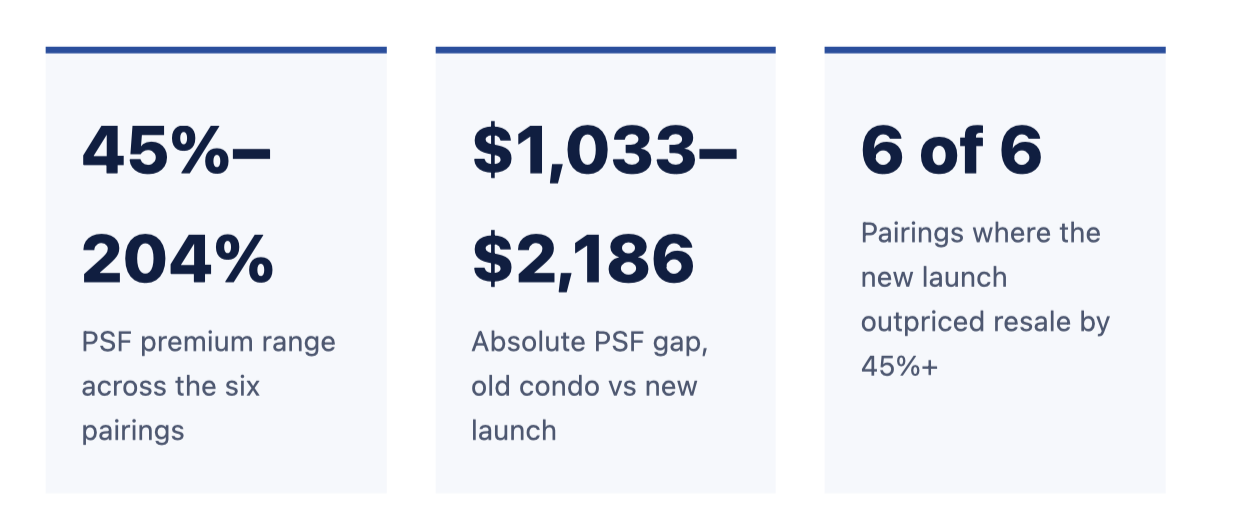
The numbers, side by side
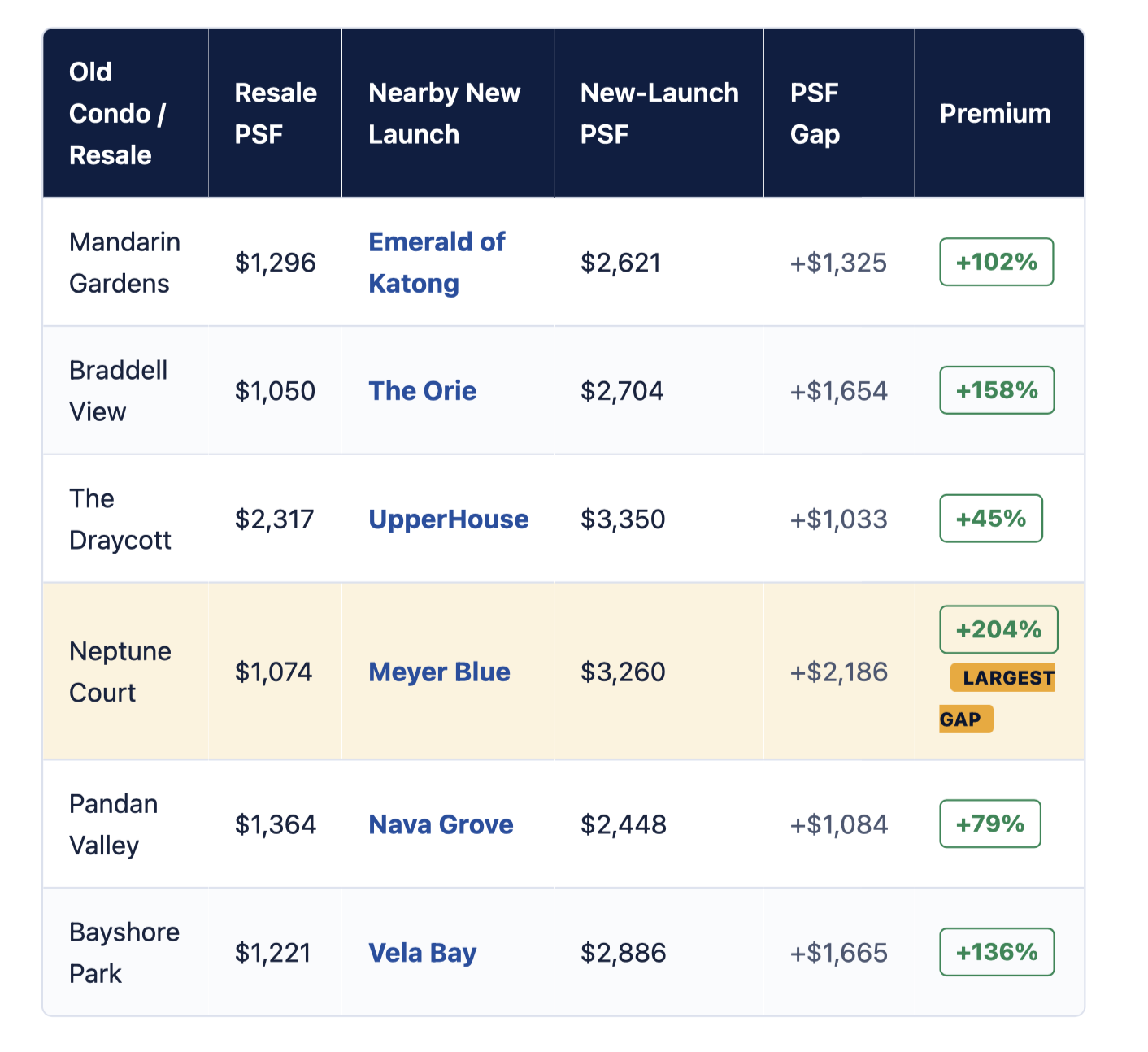
PSF figures rounded to the nearest dollar. Indicative comparison — age, tenure, unit size and exact location differ between each pairing. Sources: supplied resale transaction data and published launch reports.
Why the gap exists
Part of this is simply the cost of building today. Construction costs, financing costs and land prices have all moved up since these older estates were built, and developers are pricing new stock to reflect current replacement cost, not what the neighbourhood transacted at a decade ago.
Part of it is product. A freshly launched condo comes with a 99-year lease that hasn't started ticking down, contemporary layouts, full facilities, and a developer warranty, all of which buyers are willing to pay up for versus a 30 or 40-year-old building with shorter remaining tenure and dated fittings.
And part of it is simply scarcity. In built-up, well-located districts, there is very little new land, so each new launch effectively resets the price benchmark for everything nearby.
Why Neptune Court is the one to watch
Neptune Court vs Meyer Blue — a 204% gap
Neptune Court's resale PSF sits at $1,074. Meyer Blue, the new launch nearby, is transacting at $3,260 PSF.
That's a gap of $2,186 PSF (the widest of the six pairings we looked at, and more than triple the resale price.)
Gaps this wide are historically the exact condition that makes redevelopment economics work. When new-launch pricing in an area climbs far enough above what an old development is worth as-is, it strengthens the case for a collective sale: a developer can justify paying resale owners a premium over their current valuation and still price the redeveloped units competitively against Meyer Blue level PSFs.
When the price gap widens, en bloc opportunities can re-emerge. A wide enough spread between resale and new-launch pricing is often the first signal that a site's underlying land value has outgrown its existing building.
What this means depending on where you sit?
- If you own in one of these older estates: the widening gap is a signal worth tracking, not acting on immediately. It doesn't guarantee an en bloc attempt, but it does mean your unit's underlying land value may be running ahead of its resale price.
- If you're comparing entry points as a buyer: resale in these estates gives you a lower quantum and immediate occupancy, but at a real tenure and facilities trade-off against buying new.
- If you're weighing a new launch purchase: understanding the surrounding resale benchmark helps you judge whether the premium you're paying is in line with the district, or ahead of it.
The takeaway
None of these six pairings are identical on tenure, unit size, exact address and age all differ, and premiums this wide should be read as a directional signal, not an exact valuation. But the consistency across all six is the point: this isn't a one-estate story, it's a market-wide pattern of resale pricing lagging materially behind what buyers are paying for new stock in the same neighbourhoods.
If you're sitting on a resale unit in a mature estate and want to understand where it stands against the new launches around it or you're weighing a new-launch purchase and want the resale benchmark first, that's a conversation worth having before you make a move either way.
By Winnie Lim, licensed CEA agent and founder of AIProperty.sg
READY TO RESTRUCTURE YOUR PROPERTY PORTFOLIO?
Browse current and upcoming launches by district, then compare price, tenure and launch status on AI Property. Start exploring properties. WhatsApp me at +65 88772688.
This article is for general information only and should not be considered financial, legal, tax, or investment advice. Property decisions should be based on individual circumstances and independent professional advice.
About the Author
Winnie Lim is a licensed CEA real estate agent and the founder of AIProperty.sg. With a background in supply chain analytics, she brings a data-driven approach to Singapore property, and won the 2024 Million Dollar Award for consistent, client-first results.
CEA Salesperson Registration: R061623D · Huttons Asia Pte. Ltd (Licence L3008899K)
Read full bio →Continue Reading
More from Investment & Finance

Hougang vs Lentor New Central vs Bayshore: Singapore's 2026 OCR Land Bids Compared
Three Outside Central Region GLS sites were awarded in 2026: Hougang at ~$1,189 psf ppr, Lentor New Central at ~$1,277, and Bayshore at ~$1,323. The land-cost data, why bids keep climbing toward the DBS $2,900 psf forecast, and which site is worth watching.
23 Jul 2026
Can You Use CPF for a Second Property in Singapore? The Rules for 2026
Yes, but with strings attached. How to use CPF for a second property in 2026: the Basic Retirement Sum you must set aside first, the 100% Valuation Limit cap, the remaining-lease rule, and the accrued interest you refund on sale.
09 Jul 2026
The 99-to-1 Property Arrangement in Singapore: Legal Structure vs Illegal Loophole
The 99-to-1 property arrangement in Singapore, explained: when the 99:1 ownership split is legal, the illegal ABSD loophole IRAS is clawing back with a 50% surcharge and jail terms, and how it differs from decoupling.
06 Jul 2026