

The 99-to-1 Property Arrangement in Singapore: Legal Structure vs Illegal Loophole
06 Jul 2026 · 5 min read

CEA Salesperson Registration: R061623D · Huttons Asia Pte. Ltd (Estate Agent Licence L3008899K) · Updated 6 July 2026
“Data-driven property advice. Straight talk, no hype.”

The phrase "99-to-1" gets thrown around as if it is a clever hack, and also as if it is a crime. Both readings miss the point. The structure itself is legal and common. A particular way of using it to dodge stamp duty is not, and IRAS has spent the last two years proving it. Here is the honest line between the two.
What is a 99-to-1 arrangement?
When two or more people buy a property together as tenants in common, they can hold it in unequal shares. A 99-to-1 split simply means one owner holds 99% and the other holds 1%. Buyers use unequal shares for genuine reasons: to lean on one owner's income for the home loan, for estate planning, or to leave room for a real sale of the share later. The split on its own breaks no rules.
When 99-to-1 is legal
If both buyers are named on the Option to Purchase and the Sale and Purchase Agreement from day one, at the 99 to 1 split, the whole thing is a single transaction. Stamp duty is assessed correctly on the profile of each owner, including the 1% owner. If that 1% owner already owns another home, they pay Additional Buyer's Stamp Duty on their share from the outset. Nothing is hidden, nothing is dodged, and IRAS has no issue with it.
The illegal loophole IRAS is targeting
The abusive version is staggered into two steps. A first buyer who owes little or no ABSD signs the Option to Purchase alone and buys 100% of the property. Within weeks, that buyer transfers a 1% share to a second person, often a spouse or parent, who already owns property and would have triggered ABSD if they had been named from the start. By splitting one purchase into two steps, the buyers try to pay ABSD on just the 1% instead of on the second owner's full share. IRAS calls this what it is: tax avoidance.
What IRAS does about it
Under Section 33A of the Stamp Duties Act, the Commissioner of Stamp Duties can disregard the two steps, assess them as a single joint purchase, recover the full ABSD that should have been paid, and add a 50% surcharge on the additional duty. As of April 2024, IRAS had reviewed 187 of these cases, found 166 to involve tax avoidance, and moved to claw back about $60 million. On a $2 million purchase where $400,000 of ABSD was avoided, the bill becomes $400,000 plus a $200,000 surcharge, so $600,000, before any interest or legal costs.
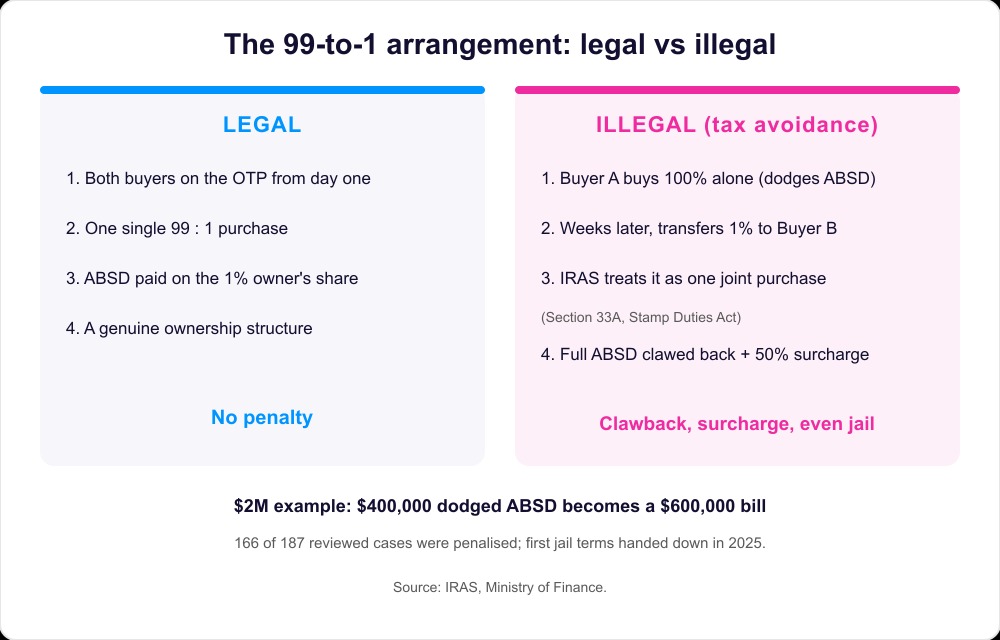
It has gone beyond money. In 2025, a mother and son became the first people to be criminally convicted over a 99-to-1 scheme under the Stamp Duties Act, and each was jailed for two weeks on top of the tax and surcharge they owed. Unpaid duty can also draw penalties of up to four times the amount outstanding.
99-to-1 versus decoupling
People mix these up. Decoupling is a genuine, later sale of one owner's share to the other, usually so the freed spouse can buy a next property as a first purchase. It is legal when it is real and the cost of decoupling comes in below the ABSD it saves. The line IRAS draws is structure and intent: a genuine transaction with commercial substance is fine, a contrived two-step purchase designed only to dodge ABSD is not. If you are weighing the legitimate routes, read how HDB upgraders avoid ABSD.
The right way to hold a property depends on your profile, your loan, and your future plans, and the wrong structure can be costly. I will map it with you, and bring in a conveyancing lawyer where needed. Ask me on WhatsApp.
Common questions about the 99-to-1 arrangement
Is a 99-to-1 property arrangement illegal?
No, not by itself. Holding a property 99 to 1 as tenants in common from the start, in a single purchase, is legal. What is illegal is the staggered version, where a buyer purchases in one name and transfers 1% to a second owner soon after, purely to avoid Additional Buyer's Stamp Duty.
What is the penalty for the 99-to-1 loophole?
Under Section 33A of the Stamp Duties Act, IRAS claws back the full ABSD and adds a 50% surcharge on the additional duty. On $400,000 of avoided ABSD that is a $600,000 bill, before interest, and in 2025 the scheme led to the first jail terms.
How does IRAS detect 99-to-1 arrangements?
IRAS reviews transactions where a property is bought in one name and a small share is transferred to a second owner shortly after. By April 2024 it had reviewed 187 such cases and found 166 to involve tax avoidance, clawing back about $60 million.
What is the difference between 99-to-1 and decoupling?
Decoupling is a genuine later sale of one owner's share, often for a real reason such as freeing a spouse to buy a first property. The abusive 99-to-1 is a contrived two-step purchase set up from the outset only to avoid ABSD. Structure and intent are what separate the two.
Can I still buy a property with my spouse in a 99:1 split?
Yes, as long as both of you are on the Option to Purchase from the start and ABSD is assessed correctly on each owner. Speak to a conveyancing lawyer before you structure ownership.
There is nothing wrong with owning a home 99 to 1 for a genuine reason, and I structure it that way for clients when it makes sense. The trouble starts the moment the goal is to dodge ABSD by splitting the purchase into two steps. IRAS has the data, the law in Section 33A, and now a record of clawbacks and jail terms. If a scheme sounds clever, run it past a conveyancing lawyer first. Saving stamp duty is never worth a criminal record.
By Winnie Lim, licensed CEA agent and founder of AIProperty.sg
Buy on the right side of the line
Stamp duty is a big number, so it is tempting to look for shortcuts. The safe savings come from getting your sequence and structure right, not from splitting a purchase to hide it. For the rates and reliefs, see our complete ABSD 2026 guide, and for the full cash picture, how much you really need to buy a condo. If you want your own purchase mapped cleanly, message me at +65 88772688.
This article is for general information only and should not be considered financial, legal, tax, or investment advice. Property decisions should be based on individual circumstances and independent professional advice.
About the Author
Winnie Lim is a licensed CEA real estate agent and the founder of AIProperty.sg. With a background in supply chain analytics, she brings a data-driven approach to Singapore property, and won the 2024 Million Dollar Award for consistent, client-first results.
CEA Salesperson Registration: R061623D · Huttons Asia Pte. Ltd (Licence L3008899K)
Read full bio →Continue Reading
More from Investment & Finance

The New‑Launch Price Gap Is Widening — And Your Old Condo May Be Sitting On It
Analysing six mature estates, resale units are trading at 45% to 204% below the new launches going up next door. Deep Dive into the gap.
04 Sept 2026
Hougang vs Lentor New Central vs Bayshore: Singapore's 2026 OCR Land Bids Compared
Three Outside Central Region GLS sites were awarded in 2026: Hougang at ~$1,189 psf ppr, Lentor New Central at ~$1,277, and Bayshore at ~$1,323. The land-cost data, why bids keep climbing toward the DBS $2,900 psf forecast, and which site is worth watching.
23 Jul 2026
Can You Use CPF for a Second Property in Singapore? The Rules for 2026
Yes, but with strings attached. How to use CPF for a second property in 2026: the Basic Retirement Sum you must set aside first, the 100% Valuation Limit cap, the remaining-lease rule, and the accrued interest you refund on sale.
09 Jul 2026